
Choosing a car in 2026 involves a trade-off that few guides address directly: the trunk size varies depending on the engine type, even within the same model. Whether thermal, hybrid, or electric, each architecture imposes constraints on battery or tank placement that alters the usable volume. Before comparing range or operating costs, it’s essential to measure what each technology consumes in loading space.
Trunk volume loss in plug-in hybrids: what the technical specifications reveal
For the same model, the plug-in hybrid (PHEV) version has a smaller trunk than the gasoline or diesel version. The traction battery, located under the trunk floor or under the rear seat, mechanically reduces the available volume.
The Kia Sportage is a documented example: the PHEV version has a significantly smaller trunk than the gasoline version, with the battery occupying space under the floor. The same phenomenon is found in several compact SUVs and station wagons from Toyota, Hyundai, or Volkswagen, where full hybrid or PHEV versions sometimes lose several dozen liters compared to their thermal equivalents.
This loss is not limited to gross volume. In some models, the spare wheel disappears in favor of a tire inflator kit, or the double storage floor becomes inaccessible. For families loading strollers, suitcases, and weekly groceries, the gap is felt on a daily basis. A trunk comparison on Auto l’Hebdo details these differences model by model, engine type by engine type.

Trunk of electric cars in 2026: catching up through architecture
The common belief that an electric car has a small trunk dates back to the early battery models, designed on converted thermal platforms. By 2026, the situation has changed for models developed from the outset on a dedicated platform.
Electric-born platforms place the battery in a skateboard configuration under the floor, freeing up space usually occupied by the transmission tunnel, fuel tank, and exhaust line. The rear trunk retains a volume comparable to, or even greater than, that of a thermal vehicle of the same size. Some models add a frunk (front trunk) where the thermal engine used to be.
However, electric vehicles built on shared platforms with thermal engines retain the implantation compromises. The floor may be raised, the loading threshold higher, and the total volume reduced.
Factors that affect the trunk space of an electric vehicle
- The type of platform: a native electric architecture preserves useful volume better than a multi-energy platform adapted afterward
- The battery capacity: a larger pack (to gain range) can encroach on the height under the floor and reduce the trunk depth
- The presence of a frunk: models with a rear motor or a small front motor offer additional storage space at the front, compensating for a potentially more compact rear trunk
Thermal, hybrid, electric: where is the trunk and usage compromise
The thermal vehicle remains the benchmark in terms of gross trunk volume in segments where platforms have not yet been rethought for electric. No traction battery to accommodate, no double floor imposed by an auxiliary electric motor. In compact sedans, station wagons, and minivans still offered in thermal, the trunk retains its regular shape and original depth.
The simple hybrid (HEV) loses less volume than the plug-in hybrid, as its battery remains of low capacity. The difference with the thermal version is often just a few liters, sometimes imperceptible in use. The PHEV, on the other hand, carries a much larger battery to provide several dozen kilometers in electric mode, and that’s where the gap widens.
Which buyer profile is most affected
Large families and professionals transporting bulky equipment are the first affected by the trunk reduction of PHEVs. For urban use with little luggage, the loss remains negligible.
The available data does not allow for a universal ranking of each engine type: the trunk volume depends as much on the chosen model as on the type of engine. An electric SUV on a dedicated platform can offer a larger trunk than a plug-in hybrid SUV of the same segment.
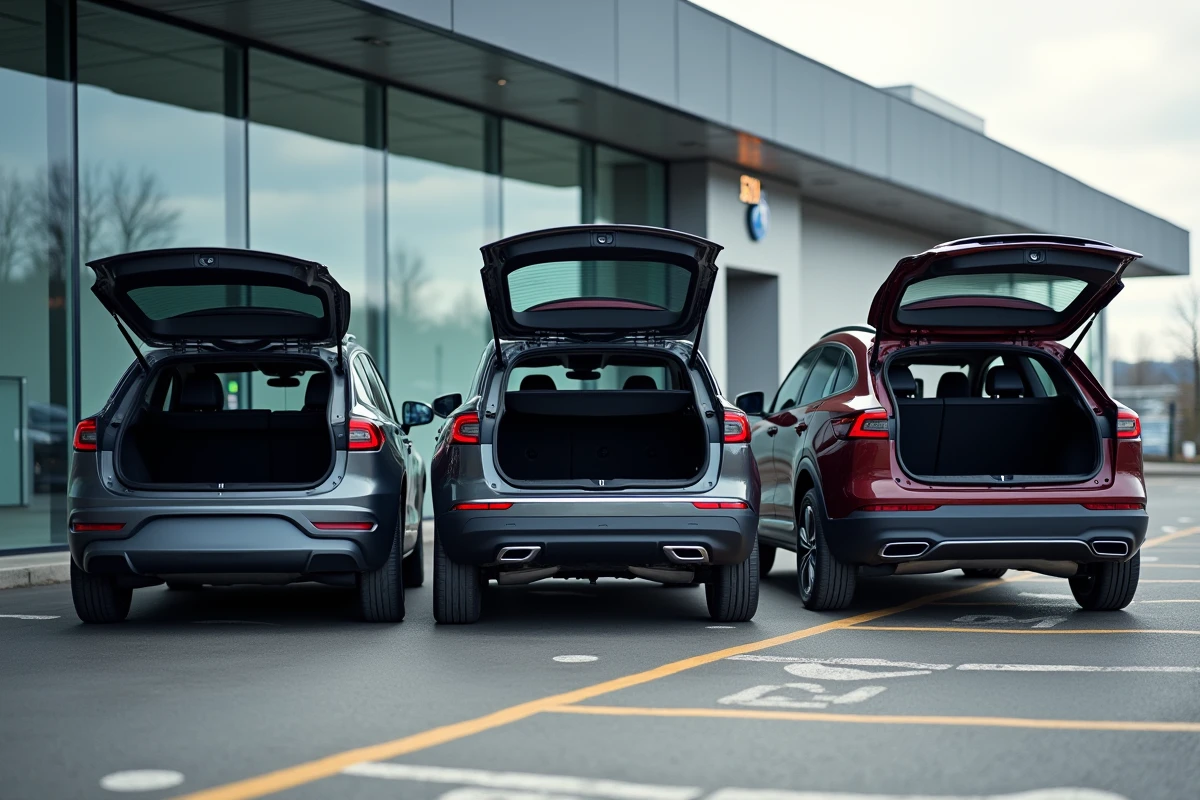
Check the actual trunk before purchase: pitfalls to avoid
The trunk volumes announced by manufacturers follow the VDA standard (measured in liters with standardized blocks), but this standard does not always reflect the space that is truly usable. An irregularly shaped trunk, a high loading threshold, or a sloping floor reduces practical capacity without changing the official figure.
- Compare the “raised floor” and “lowered floor” volumes: on hybrids, the raised floor hides the battery but reduces the loading height
- Check for the presence or absence of a spare tire, as its removal artificially inflates the announced volume
- Physically test the trunk with your own luggage or equipment, as the shape of the trunk matters as much as the volume in liters
For electric models with a frunk, the announced volume sometimes adds the front trunk and rear trunk together. A flattering total can mask a rear trunk that is smaller compared to a competing thermal model.
Choosing an engine type in 2026 is not just about cost per kilometer or range. For anyone who regularly loads a trunk, checking the actual volume according to the engine type avoids disappointment that neither the energy label nor the catalog price reveals.