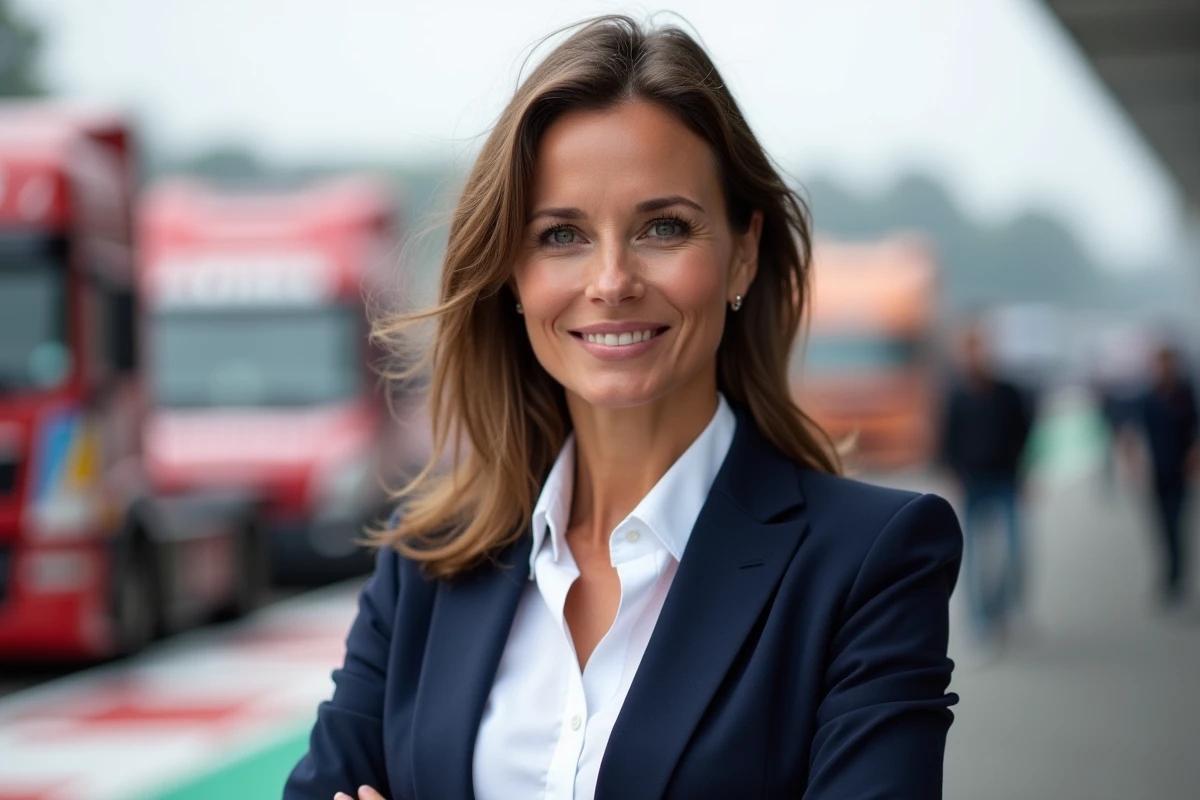
Laurène Godey occupies the right seat of Sébastien Loeb in the French Rally Championship. This status as a professional co-driver, validated by victories in national gravel events, radically distinguishes her from the “champion’s partner” image that the tabloid press often assigns to her.
Co-driver in the French Rally Championship: the profession behind the title
The role of a co-driver in rallying is far from honorary. The reading of notes, the timing of calls in stages where the car is driven at the limit of grip, the management of stress in national competition: all of this requires a technical skill that can only be acquired through years of practice.
Laurène Godey has established herself in this role alongside Sébastien Loeb in events of the French Championship, with documented victories notably in gravel rallies. The duo won the Rally Vosges Grand Est, a benchmark event on the national circuit. This record places her among the most prominent active co-drivers in French rallying.
The journey of Laurène Godey, Sébastien Loeb’s partner deserves to be viewed through this professional lens, often overshadowed by the sentimental angle.
The credibility of a co-driver is measured by their consistency over several seasons and their ability to adapt to different race formats. The transition from asphalt to gravel radically alters the rhythm of the notes and the management of the announced trajectories. The fact that Godey has performed on gravel alongside a nine-time WRC world champion speaks volumes about her actual level.
Laurène Godey and biographical discretion: a deliberate choice
Most online articles attempt to provide an age, a date of birth, an educational background. None succeed in a sourced manner, and for good reason: Laurène Godey’s exact date of birth is not publicly available. Neither she, nor the teams, nor the federation have communicated it.
This ambiguity is not an oversight. The age estimates circulating are not based on any identified primary source. The age gap with Loeb, frequently mentioned in Google searches, has never been quantified in a verifiable way.
This intentional management of biographical discretion contrasts with the media exposure that comes with sharing the life and cockpit of one of France’s most famous athletes. Godey controls what she shows: her racing performances are public, her private life remains locked down.
What this discretion reveals about the rallying world
French motorsport, unlike football or tennis, does not generate systematic tabloid coverage for co-drivers. Laurène Godey benefits from this relative structural protection, but she actively reinforces it by not feeding the media’s biographical requests.
The result: the profiles that circulate recycle all the same partial information, without ever accessing verifiable data. Her Vosges origins are mentioned in several sources, but the details of her journey before rallying remain largely unknown.
Loeb-Godey duo in French rallying: results and functioning
Sébastien Loeb, after his career in WRC and his participation in Dakar, chose to return to national French rallies. This return was made with Laurène Godey in the right seat, not with a co-driver from the historical WRC background.
This choice is not trivial. Loeb navigated for years with Daniel Elena, his historical co-driver. Working with a new co-driver requires a complete reconstruction of the automatic responses:
- The rhythm of reading notes must match the driving style, which takes several events of adjustment
- Trust in corner calls (tightening, opening, braking distance) is built only in real racing situations
- The management of reconnaissance, where the co-driver writes and organizes the notes, reflects a working method that must be compatible with that of the driver
The fact that the duo has quickly won national events indicates a technical compatibility that goes beyond mere personal rapport. In rallying, a driver-co-driver couple that does not function well in the cockpit does not win, regardless of their relationship outside.
Laurène Godey beyond rallying: media presence and positioning
On social media, the Loeb-Godey couple appears regularly, but always in a context related to motorsport. The posts shared by specialized pages (French Rally Championship, rally fan pages) show a calibrated presence.
Godey has not developed a personal brand as a sports influencer. Her visibility remains indexed on racing results and on content produced by the rally ecosystem. This positioning differentiates her from many partners of high-level athletes who capitalize on their spouse’s notoriety to build their own audience.
Shared automotive passion or simple professional proximity
The question often arises: did their relationship begin in the paddock or did it exist beforehand? The available sources do not allow for a definitive answer. What is documented is that their professional collaboration as driver and co-driver predates their exposure as a couple in specialized media.
This timeline matters. It anchors Godey in the rallying world as a professional before situating her as a partner. Motorsport remains a realm where technical competence determines one’s place in the crew, not relational status.
Laurène Godey embodies a still rare profile in French rallying: a high-performing co-driver at the national level and the partner of the driver. This dual role, far from being a mere tabloid curiosity, raises the question of the recognition of co-drivers in a sport where only the driver’s name makes the headlines. The results in the French Championship speak for her, and that is probably the only biography that matters to her.