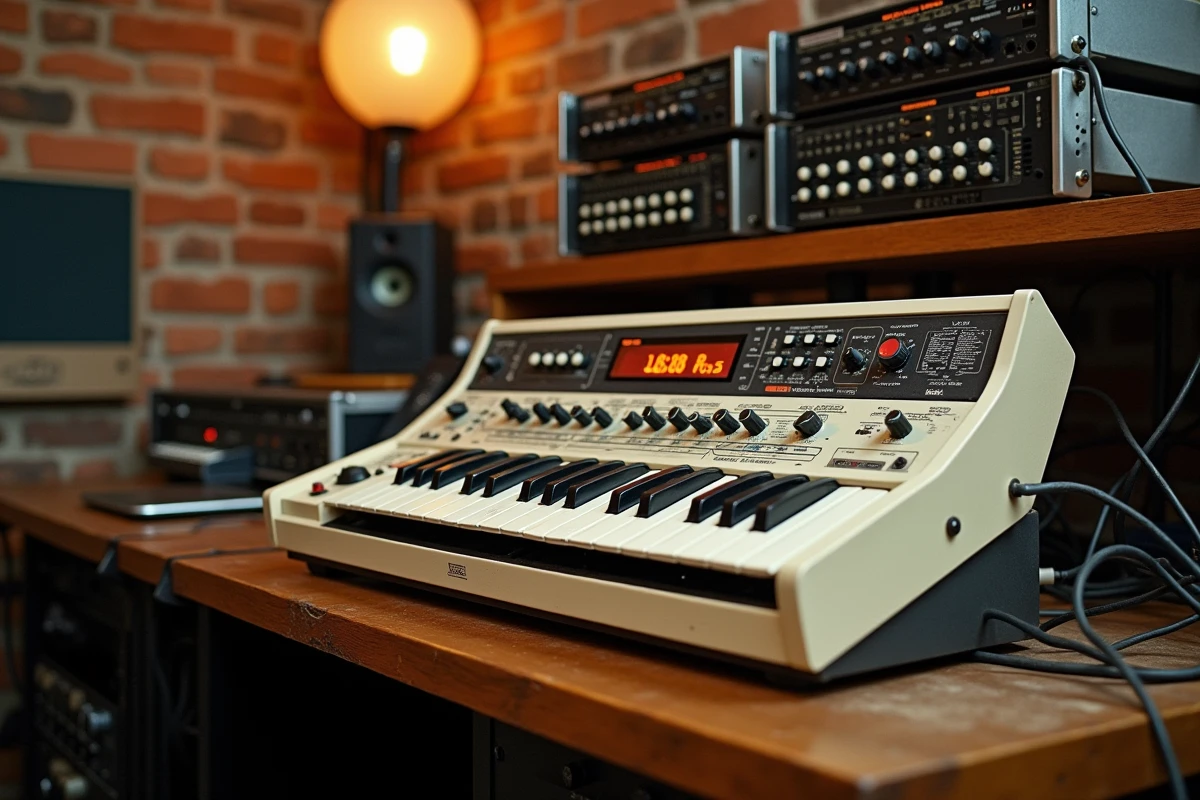
The number 808 appears everywhere: in track titles, band names, and audio plugin interfaces. Behind these three digits lies a drum machine made by Roland in the early 1980s, the TR-808 Rhythm Composer. Its name has become a universal shorthand for a type of bass, a sound grain, sometimes an entire musical genre.
Understanding where this name comes from, and why it has survived beyond the machine itself, requires delving into Roland’s industrial logic. One must then follow the improbable journey of an instrument that was initially a commercial failure.
TR-808: what each part of the name means at Roland
The prefix “TR” is not mysterious once placed within the Roland catalog. It stands for Transistor Rhythm, a designation used by the Japanese manufacturer for its entire range of programmable drum machines. This prefix can be found on the TR-33, the TR-55, then the TR-606, the TR-707, the TR-727, and the TR-909.
The number 808, on the other hand, stems from an internal numbering policy. Roland organized its products by series (100, 200, 300, 500, 700, 800), with higher-numbered series generally corresponding to more ambitious or expensive models. The 8xx series appears in other ranges: the Jupiter-8 for synthesizers, some SH-8 models. The “808” is therefore not a secret code or a wink, it is just a catalog number among others.
Several forums and articles suggest that 808 could refer to the American penal code for disturbing the peace. No reliable source confirms this link with Roland’s intent. As explained in detail by the meaning of the name 808 on Web United, the origin remains strictly industrial.

Defective transistors and analog sound: why each TR-808 sounds different
The TR-808 is a fully analog machine. Its sounds are not recordings of real drums, but signals generated by electronic circuits. This technical choice has a direct consequence on the cult status of the instrument.
The most documented point concerns the transistors used for generating white noise (hi-hat, snare, claps). Roland integrated NEC transistors from the 2SC828-R series, a batch that the component manufacturer deemed defective and unusable for other applications. These transistors produced unwanted noise that Roland repurposed to create the percussive textures of the machine.
The practical consequence: two TR-808s never sound exactly the same. Variations between batches of transistors give each unit a slightly different grain. When the production of these components ceased, Roland could no longer manufacture the machine identically, which contributed to halting its production after just a few years.
A commercial failure turned rarity
Upon its release, the TR-808 did not convince professional musicians. Its sounds did not resemble a real drum kit, which was a dealbreaker for the target market. Unsold machines ended up on the second-hand market at very low prices, accessible to musicians who could not afford digital sample drum machines.
It is precisely this accessibility that allowed the TR-808 to end up in the hands of hip-hop, electro, and house producers in New York, Detroit, and Chicago. The machine found its audience by accident.
From disco to hip-hop: how the 808 sound crossed musical genres
The journey of the TR-808 in popular music follows a geographical and social logic as much as a sonic one. Several stages consolidated its status:
- In the early 1980s, funk and soul producers used the machine for its rhythmic programming capabilities, notably its accent function that allows modulation of the dynamics of each step in the sequencer.
- In the clubs of Chicago and Detroit, the TR-808 became a staple of emerging house and techno. Its deep, long kick, tunable in pitch, gives tracks a low-end foundation that club sound systems reproduce with physical power.
- New York hip-hop and radio production in the 1980s adopted the machine for its deep bass. Afrika Bambaataa’s track “Planet Rock,” released in 1982, is one of the first hits to place the 808 sound at the center of production.
- Trap, starting in the 2000s, pushed the 808 bass to its limits: saturated, tuned to melodic notes, it became a full-fledged instrument rather than just a kit element.
The term “808” gradually ceased to refer to the machine and became the generic name for a type of bass sound. In current trap production, most “808s” are redrawn samples or synthesizers that have no material link to the original TR-808.
Why the name 808 remains iconic despite the machine’s disappearance
The TR-808 has not been manufactured in its original form since the 1980s. Roland offers reissues and software emulations, but the original analog machine is a collector’s item. The name, however, continues to circulate.
Several factors explain this longevity. The first is musical: the 808 bass occupies a frequency range that few other instruments fill as effectively. The deep sub-bass of the 808 has become a production standard in hip-hop, pop, and electronic music.
The second factor is cultural. The group 808 State, Kanye West’s track “808s & Heartbreak,” the countless references in rap: the number 808 functions as a marker of belonging to a musical culture. Saying “808” in a studio invokes a lineage that stretches from the boogie of the 1980s to contemporary trap.
The third factor is technical. Plugins and sample packs labeled “808” number in the hundreds. The name has become a category of sound in production libraries, alongside “piano” or “strings.” This lexical normalization ensures that the term will survive all trends.
Three digits on the gray casing of a Japanese machine from the 1980s have ended up naming an entire facet of global music production. The name 808 was not chosen to mark history; it simply designated the eighth model in a series of transistor drum machines. It is the music that has given it its weight.